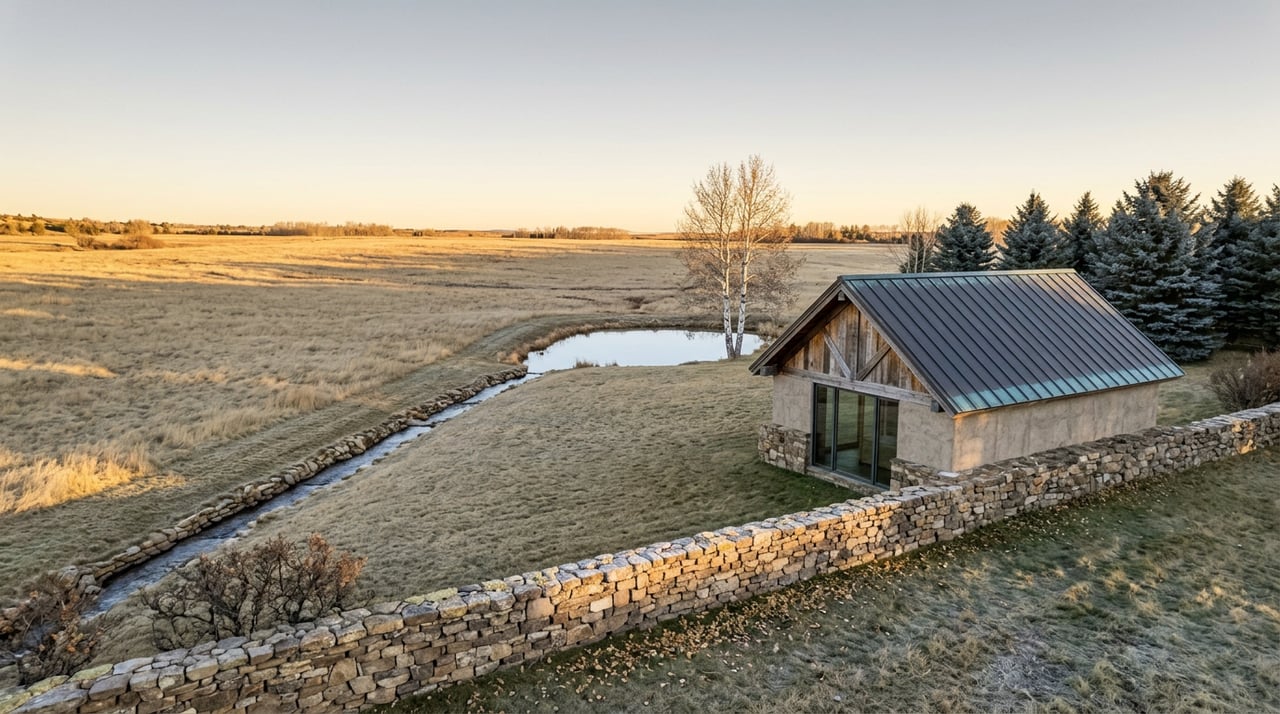
Drive Capitol Creek Road on a clear night and you already know the stretch that goes truly black. For 70 years, that patch belonged to St. Benedict's Monastery, a valley of ranchland and cottonwoods where five Trappist monks lived by a rule that asked for silence, plain living, and almost no artificial light. Nobody wrote that down as a zoning requirement. It was just how the brothers chose to live.
That changed twice in the past year, and the two changes are more connected than they look. The monastery sold in December 2025 for $120 million, the most expensive residential transaction in Pitkin County's history, and held its final public Mass on January 11, 2026. Just over two months after the sale closed, Old Snowmass was certified in February 2026 as an International Dark Sky Community, joining a list of only 20 certified dark sky places in Colorado and 273 worldwide. The land that used to keep itself dark by vow just got sold to a private owner. The valley around it just got a law that requires the same thing from everyone else.
Two Stories That Are Actually One
It would be easy to file these as unrelated items: a big real estate sale, a nice environmental award. They're the same transition. When an institution that asked for nothing in return leaves a landscape, something else has to take over the job of keeping it the way it was, and that something is usually a code, a curfew, and an enforcement schedule. That's exactly what happened here. The monastery's departure didn't just change who owns 3,739 acres on Capitol Creek Road. It closed the loop on why Pitkin County spent the past 14 months rewriting, in numeric detail, what darkness is supposed to look like on everyone else's property.
What Actually Sold on Capitol Creek Road
The monastery had been for sale since April 2024, originally listed at $150 million. The Trappist order's leadership had voted to close it back in the fall of 2022, citing an aging and shrinking community of monks. Attendance at daily Mass had fallen from 18 monks in 2009 to five by the time the closure was announced. The retreat house and bookstore shut down in 2023, and the property went to market the following spring with listing agents publicly saying they hoped for a conservation-minded buyer.
That buyer turned out to be recorded under the name Espen LLC, a Delaware entity, in the deed filed with the Pitkin County Clerk and Recorder on December 15, 2025. The Wall Street Journal reported the following day that the actual purchaser was Alex Karp, the CEO of Palantir Technologies, whose net worth Bloomberg has placed near $18 billion. The Journal also reported that Karp intends to use the property as a residence and has indicated he wants to work with those who have cared for the land.
$120 million for 3,739 acres. Pitkin County's most expensive residential sale on record, recorded December 15, 2025.
What the sale didn't include is any change to how the land can be used. This was a residential transaction, not a rezoning, and the monastery's roughly 3,700 acres remain under the same rural land-use designation they carried under the monks. One detail did get written into the deed: an access easement preserving the right of Trappist order members and the families of those buried in the monastery cemetery, including the well-known contemplative writer Father Thomas Keating, to continue visiting the gravesites. As of the weeks right after the sale, the gravel road up to the monastery was still open for anyone to walk. Whether that stays true is now up to a private owner, not a religious community with no interest in restricting it.
Four of the five remaining monks have since relocated, three to the order's mother house in Massachusetts and one to a monastery in Oregon. One longtime ranch manager stayed on to help the new owner learn the property.
What Changed Under Everyone Else's Porch Light
While the monastery sale was working its way through listing agents and closing documents, Pitkin County was rewriting its lighting code from the ground up, and the timing lines up almost exactly.
In January 2025, county commissioners adopted the first version of a real curfew: exterior lights off between 10 p.m. and 6 a.m., a light-trespass limit of 0.2 foot-candles measured at the property line, and a formula capping single-family homes at 3.5 lumens per square foot of above-grade floor area, with a hard ceiling of 35,000 lumens regardless of house size. Fixtures already in place that didn't meet the new rules got a five-year amortization window to be replaced, putting the practical compliance deadline somewhere around 2030 for anyone who hasn't already swapped their fixtures.
Less than a year later, in December 2025, commissioners took up a second, more technical rewrite: three mapped lighting zones across the county, from LZ-0 in the most remote and rural areas (the zone that covers most of Old Snowmass) up to LZ-1 for mixed rural-suburban land and LZ-2 near the airport and West Maroon corridor, each with its own per-fixture lumen caps. The rewrite also converted the county's older watt-based lighting standard to a lumen-based one, which sounds technical but matters in practice: watts measure how much energy a bulb uses, lumens measure how much light actually leaves it, and modern LEDs can throw far more light per watt than the fixtures the old code was written around.
| Before (pre-2025) | After (adopted 2025, refined into 2026) | |
|---|---|---|
| Curfew | None | 10 p.m. to 6 a.m., exterior lights off |
| Brightness standard | Watts | Lumens, with per-fixture caps by zone |
| Light trespass limit | Not defined | 0.2 foot-candles at the property line |
| Noncompliant fixtures | No deadline | 5-year amortization window |
Martha Ferguson, the Old Snowmass resident who founded the advocacy group WildSky Old Snowmass under the umbrella of the Snowmass Capitol Creek Caucus, pushed both rounds of this code through county hearings. Her argument to commissioners was straightforward: the valley's skies were getting brighter as more people moved in and installed lighting they liked without realizing what it was doing to neighbors, wildlife, and the character of the place. Pitkin County Commissioner Jeffrey Woodruff, who represents the district that includes Old Snowmass, backed the effort publicly and separately spoke about the monastery's stewardship of the land in terms of wildlife and watershed protection, the same values the lighting code was written to protect.
Why the Certification Came Right After, Not Before
DarkSky International's own criteria explain why the timing matters. A community can't earn certification on advocacy alone. It needs an enforceable lighting ordinance already adopted, plus documented community outreach, a sky-brightness monitoring program, and an inventory of publicly owned lighting. Old Snowmass had the advocacy for years. What it didn't have until early 2026 was a code with teeth, curfew hours, foot-candle thresholds, and zone-specific lumen caps that a code enforcement officer could actually cite.
That's the piece that connects both stories. The monastery didn't need an ordinance to stay dark because a religious order's daily rhythm did the job. Once that rhythm left the valley, replaced by a single private owner under an LLC, the only way to guarantee the same outcome for the rest of Old Snowmass was to write it into county code and give it a five-year enforcement clock.
What This Actually Means If You Live Here
- Check your own exterior fixtures against the 3.5 lumens per square foot cap. If your porch, garage, or landscape lighting predates the 2025 rewrite, you likely have until roughly 2030 before it needs to be shielded or replaced, but new installations are held to the current standard immediately.
- The 10 p.m. to 6 a.m. curfew applies to exterior lights on your property, not just streetlights or commercial signage. Motion sensors and short-timer photocells are exempted, so a lot of security lighting already qualifies without changes.
- If you've walked or ridden up Monastery Road out of habit, that access now depends on a private owner's preference rather than an open-door policy from a religious community. Nothing has been publicly restricted as of this writing, but nothing guarantees it stays open either.
- The cemetery easement is narrow by design: it protects visitation rights for Trappist order members and direct families of those buried there, not general public access to the grounds.
The valley looks the same from Highway 82. What changed is who's responsible for keeping it that way, and how specifically the county can now hold them to it.
If you're weighing what a shift like this means for property values, land use, or the long-term character of Capitol Creek Valley and the rest of Old Snowmass, Saslove & Warwick has spent decades reading exactly this kind of local signal for clients who care about more than the listing photos. Contact Us.